
Why CARTA works
CARTA gives you the tools. SIGNAL Arc helps you use them correctly.
Cannabinoids as a system anchor
Most wellness systems rely on inputs that are either too subtle to track or too inconsistent to scale. Cannabinoids are different.
Rather than targeting a single pathway, cannabinoids interact with broad regulatory systems involved in stress, mood, sleep, inflammation, and recovery. This makes them inherently modulatory — capable of supporting balance rather than forcing a fixed outcome.
When combined with terpene profiles, their effects become more directional and predictable. Adaptogens can then be layered alongside them to support longer-term physiological alignment.
In the CARTA system, non-intoxicating cannabinoids form the foundation: stable, repeatable, and adjustable over time. This creates a baseline that users can rely on daily.
From there, intensity becomes optional. Adult-use cannabis can be layered on top — not as a replacement for the system, but as an intentional extension of it. This allows users to separate consistency from variability, and control each independently.
Combined with deep expertise in cultivation, formulation, and genetics, CARTA provides a rare combination of biological relevance, user-perceivable impact, and system-level scalability.
A stable foundation only becomes useful when it can be measured and improved
The system is designed to keep three things connected: what was used, how it felt, and what should change next.
That is what turns a promising ingredient into a repeatable routine.
- Stable foundation — so the baseline is interpretable.
- Measurable inputs — so adjustments are visible.
- Continuous feedback — so the next decision gets better.
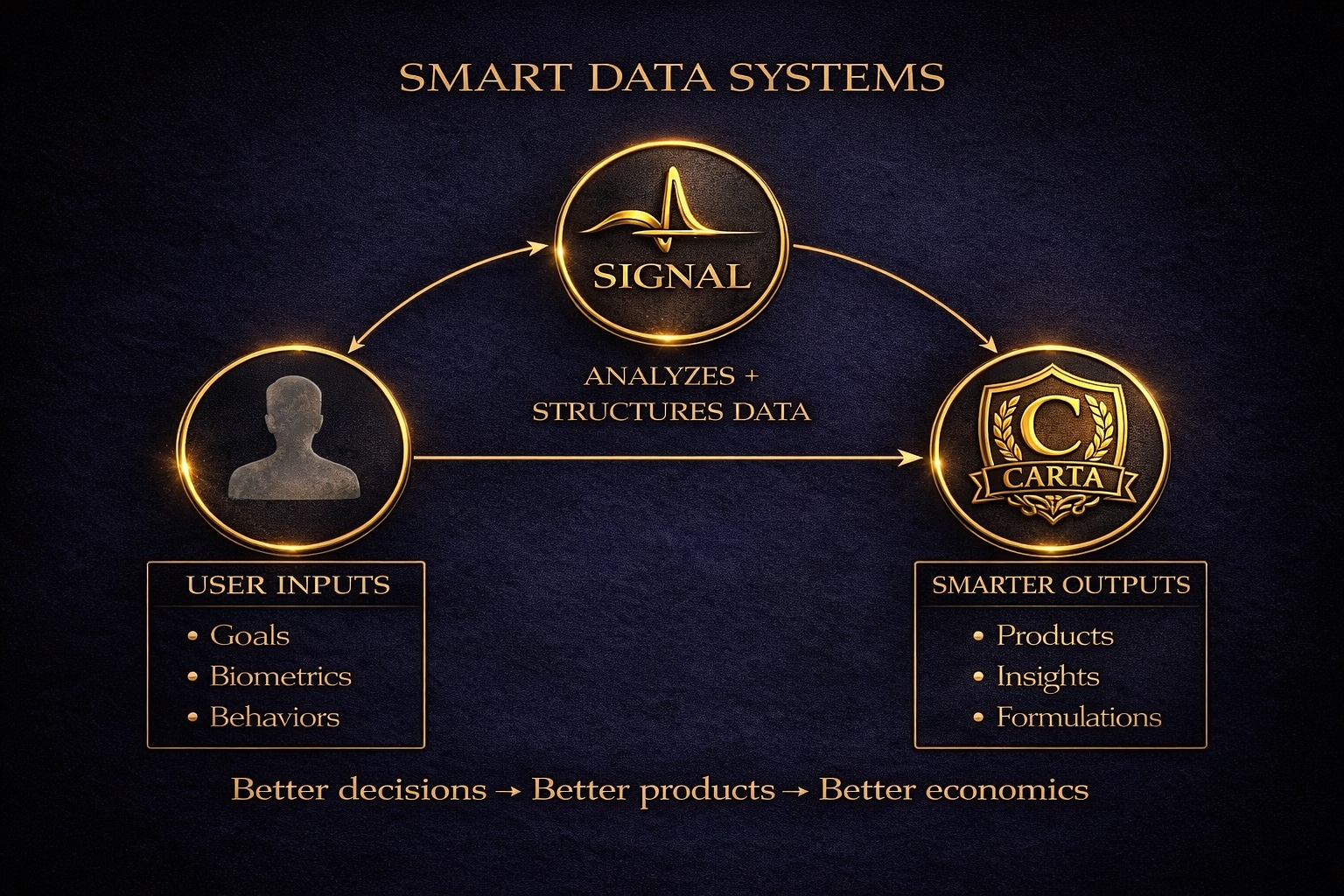
Consistency is the advantage.
The value is not just the products. It is the structure underneath them — the part that keeps the system understandable, adjustable, and repeatable over time.
Start With Your Goal